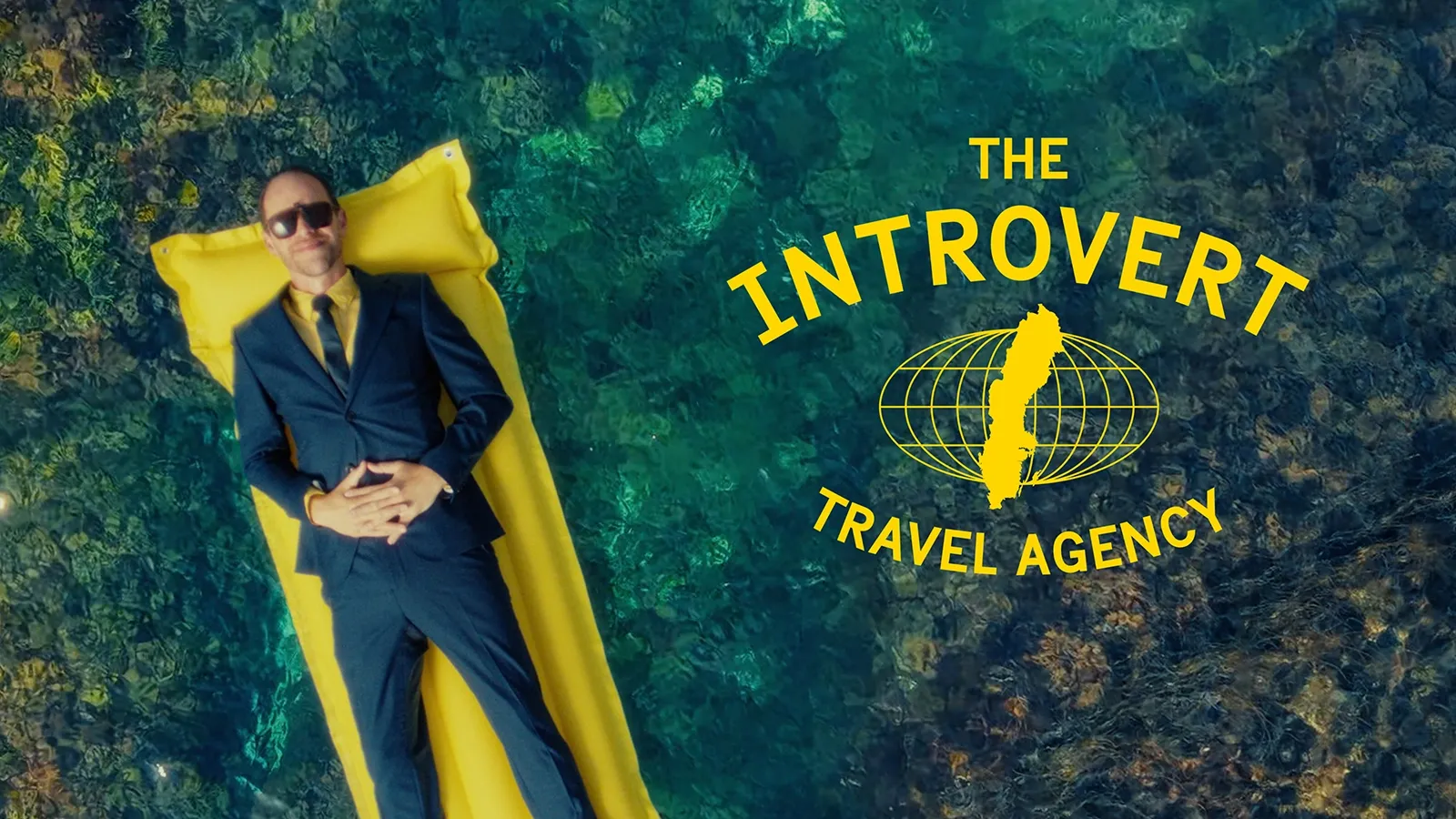
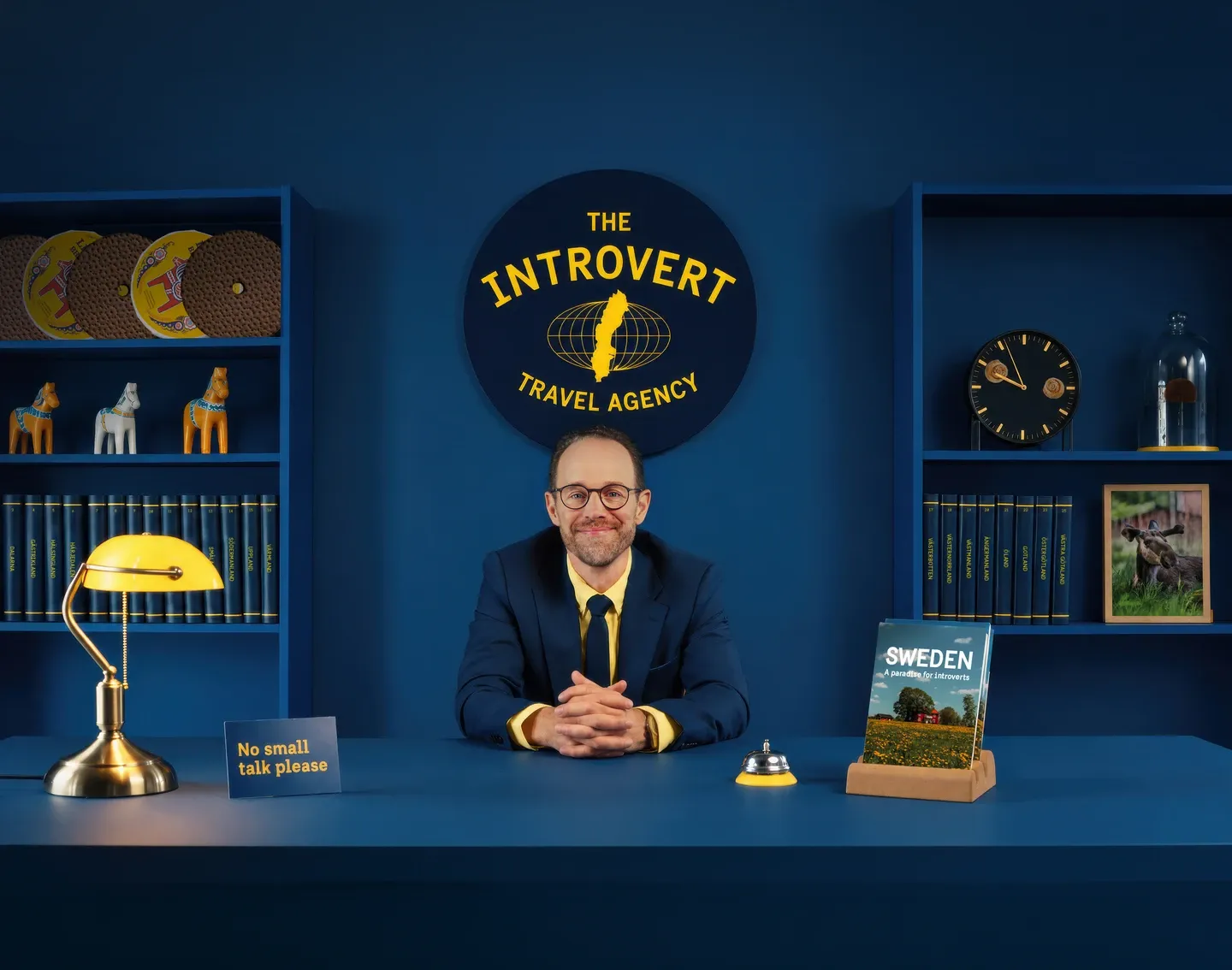
For anyone who has ever needed a holiday after their holiday, it’s a welcome change. For marketers and creators, it’s also an interesting example of how to take a quality some brands might see as a disadvantage and turn it into a recognisable marketing concept.
When Data Shows That Quiet Is Not a Niche Need
Good marketing doesn’t begin with a creative team sitting in a boardroom and brainstorming new ways to shout at people. It starts with understanding what an audience actually needs. Visit Sweden also came to its new campaign with some interesting data.
A YouGov survey commissioned by the organisation found that 48% of respondents in the UK primarily identify as introverts. The research covered 9,212 adults aged 18 and over across nine countries. Data was collected from June 26 to July 6, 2026. Alongside the UK, respondents came from the United States, France, Germany, the Netherlands, Sweden, Norway, Denmark and Finland.
Other results are interesting too. Visit Sweden says 79% of British respondents feel more rested after spending time alone, while 72% said social settings become exhausting for them after a while.
That is a pretty good reason to ask whether travel promotion sometimes focuses too much on the number of experiences and forgets about rest itself.
But there is one important caveat: being an introvert does not automatically mean someone dislikes people, fears group tours or wants to spend a whole week alone in the woods. The survey shows how respondents describe themselves and how they answered questions about time alone and social settings. It does not prove that introverts reject conventional travel agencies or that the tourism industry systematically overlooks them.
Visit Sweden used the data as an opportunity to reach people who value calm and the ability to choose how much social contact they want while travelling. Sweden has plenty to offer them: vast forests, lakes, coastlines and many places away from the main tourist routes.
Instead of trying to convince everyone that the country offers the wildest holiday on earth, Visit Sweden took a different path. That is what makes the campaign interesting from a marketing perspective.
A Travel Agency That Doesn’t Push You
The Introvert Travel Agency did not stop at online communication. Visit Sweden also planned a series of temporary pop-ups in three European capitals.
In Berlin, the agency was scheduled to open October 14–17, 2026, at Prinzenstraße 84.2, from 11 a.m. to 7 p.m. each day. Paris was next, October 21–24, at 2 bis rue Commines, open from 10 a.m. to 7 p.m. The series was to conclude in London, October 28–31, at 3 Paddington Street in Marylebone, open from 10 a.m. to 6 p.m.
The physical pop-ups complement the online campaign, which presents Swedish destinations and experiences from the perspective of introverted travellers. Visitors take a short quiz on the website and receive six suggested travel packages, along with more inspiration for planning a trip.
One important detail: Visit Sweden does not sell or book the trips itself. The recommended packages can be booked through selected external travel companies. So this is not a conventional travel agency in the traditional sense, but a creative concept connecting promotion of the country with inspiration for visiting it.
And this is where the idea becomes interesting. Conventional travel advertising often shows everything you can fit into a holiday. This campaign flips the perspective: what if the greatest luxury were not doing more, but not having to do anything at all?
You don’t need every day planned from morning to night. You don’t have to join every activity. And you don’t need to turn your holiday into another project with deadlines, goals and a performance spreadsheet.
For some travellers, that is far more appealing than another list of ten places they supposedly have to visit before heading home.
The Art of Laughing at Yourself
At the centre of the campaign is a short promotional film that presents Sweden as a destination for introverted travellers. Instead of traditional images of a perfect holiday it uses humour, personal space and the idea of someone wanting a break from constant social contact.
The campaign uses self-deprecation and cultural stereotypes to show Sweden from a different perspective. Personal space is not a problem to overcome; it becomes one of the strengths the destination can build its communication around.
If you hate small talk with strangers, you don’t automatically have to change your personality. And if you don’t want to go out every evening, that doesn’t mean you don’t know how to travel.
Of course, this is not a claim that all Swedes dislike small talk or that every introvert feels best alone. That would be just as inaccurate as assuming every tourist wants a crowded bar and an organised excursion. The campaign uses exaggeration, not a universal psychological profile of an entire country.
Its main message is simple: a holiday does not have to be a social performance. You can choose who you spend time with, how many activities you plan and when you need a break from it all.
Nature Without Racing Through an Itinerary
One of the most interesting parts of Sweden’s offer is its right of public access, known as allemansrätten. Under certain conditions, it allows people to move through the countryside and enjoy nature beyond designated hiking trails.
That does not mean you can go anywhere without restriction. The right of public access comes with a responsibility to respect nature, private property and other people. Special rules may also apply in protected areas.
For travellers looking for a quieter kind of holiday, however, this approach is appealing. Sweden’s forests, lakes and coastal areas offer plenty of ways to explore at your own pace, stop wherever something catches your eye or plan a day without a fixed schedule.
Of course, no one can guarantee that you won’t meet a single person all day in Sweden. It depends on the location, season and route. But you don’t have to book, tick off and post every experience to Instagram for it to matter.
That is the difference between promising absolute solitude and offering genuine freedom. The first would be an exaggeration. The second is much more interesting for a travel brand.
Fika: Because Introverts Like Coffee Too
Swedish culture also has fika, a traditional coffee break often accompanied by something sweet. It might be time with colleagues, a moment with friends or simply an ordinary pause in the day.
Fika is a reminder that social contact does not have to mean an endless party or the obligation to entertain the whole room. Sometimes it is just coffee, something good to eat and a short moment with people you want to be around.
It would be an overstatement to call it an introvert’s custom or say that it requires no social energy. Fika is part of broader Swedish culture, and what it looks like depends on the situation and the people sharing it.
In the context of the campaign, something else matters more: you don’t have to choose between constant company and complete isolation. You can have coffee with friends, spend the afternoon in the woods and decide not to go anywhere that evening. No pressure to live up to anyone’s idea of a perfect holiday.
And that is a pretty good approach to travel, whether you consider yourself an introvert or an extrovert.
Freedom of Choice as the Greatest Luxury
The project’s central idea is also reflected in a statement from Visit Sweden CEO Susanne Andersson. Many travellers, she says, want to decide when they are in the company of others and when they would rather be alone. Sweden, the organisation says, offers room for both—in nature, in cities and in everyday life.
The Introvert Travel Agency aims to introduce the country to people who want to travel on their own terms. Social contact is not presented as a bad thing. The emphasis is on having a choice.
And that points to a broader theme beyond tourism. In a world that often prizes productivity, constant availability and the ability to fit in as many activities as possible, the chance to slow down can be surprisingly appealing.
You don’t have to turn every weekend into a marathon of experiences. You don’t have to feel that a day off is wasted if you didn’t go anywhere. And you don’t need to apologise for sometimes simply not feeling like being around people.
That does not mean all introverts want the same things or that Sweden is a place where everyone automatically respects the need for solitude. But the campaign is a reminder that personal space can be a legitimate part of a travel experience, not a shortcoming.
When a Brand Builds on Its Own Identity
Visit Sweden has long used creative campaigns to present the country from different perspectives. Promotion can work with culture, local customs and everyday life as well as nature and tourist attractions.
The Introvert Travel Agency continues that approach. It does not just sell a list of places worth visiting; it offers a specific idea of how someone might experience the country.
The brand does not have to pretend Sweden is the best destination for absolutely everyone. It does not need to compete with seaside resorts on the number of beach bars or with big cities on nightlife. It can highlight other qualities in its offer and speak to people who genuinely value them.
That is the important difference between being distinctive and having a mere advertising slogan. Saying that something is different is not enough. A brand needs to show how it is different and why that should matter to a customer.
In Sweden’s case, it is the combination of expansive nature, the option to explore independently and a cultural image the campaign uses with a wink. Whether the idea brings more visitors, more bookings or a stronger long-term relationship with the brand can only be judged by results.
The idea itself is worth paying attention to—not because it guarantees commercial success, but because it shows how an existing offer can be presented differently from the competition.
Why This Strategy Works as Marketing
The Introvert Travel Agency offers a few useful lessons for anyone creating content or building a brand. And no, you don’t have to start selling holidays in the woods.
1. When Everyone Shouts, You Can Whisper
In many industries, brands compete with more promises, louder visuals and endless lists of benefits. But if everyone communicates in the same way, another loud ad may not offer anything new.
Visit Sweden took a different angle. Instead of adding more experiences to an already crowded list, it built its communication around the option to slow down.
A useful reminder for any brand: sometimes you don’t need to expand the offer. You only need to change the way you talk about it.
2. You Don’t Have to Speak to Everyone
The figure of 48% of British respondents identifying as introverts is an interesting starting point for a conversation about travel preferences. It does not mean that nearly half the UK market is automatically looking for a quiet, solitary holiday.
This is where it is important to distinguish between a demographic figure, a psychological trait and actual purchasing behaviour.
Good segmentation is not based only on how people describe themselves. It also looks at their needs, decisions and reasons for choosing a particular product. Visit Sweden has an interesting starting point in its survey, but it would need more data to establish the group’s real commercial potential.
The simple lesson for your brand: you don’t need to appeal to everyone. But you should know whom you want to reach, what you offer them and why they should care.
3. Difference Needs to Be Grounded in a Real Offer
Sweden has vast natural landscapes, lakes, forests and many ways to travel outside the busiest tourist areas. The campaign connects these qualities with the need for personal space.
So it is not just an advertising phrase. The story is backed by features of the destination a visitor can actually experience, though of course not everywhere and in every circumstance.
The same principle works in other industries. To distinguish your brand, find a real quality of your product or service that matters to a particular group of customers. Simply giving it a new name and hoping someone notices is not enough.
4. Humour Can Be Stronger Than Another List of Benefits
The campaign uses exaggeration and cultural stereotypes to present Sweden in an unexpected way. Instead of explaining at length why personal space matters, it relies on situations part of the audience can immediately picture.
That does not mean humour works everywhere, every time. It has to suit the brand, the audience and the subject. But when it can turn a complicated thought into a clear, memorable message, it may be more effective than another list of features.
5. A Good Idea Is Not Proof of Commercial Success
It is important to stay grounded here. A creative concept can be interesting, distinctive and built around a relevant topic. That alone does not prove it will bring more bookings or increase customer loyalty over time.
To know that, you would need to track concrete results: interest in the campaign, website traffic, engagement with offers, bookings or changes in brand perception.
That distinction separates an inspiring marketing analysis from simple enthusiasm for a good ad. We can appreciate a strong idea without automatically crediting it with results that have not yet been demonstrated.
You Don’t Have to Sell Everything to Everyone
The Introvert Travel Agency is a reminder that a brand’s distinctiveness does not have to come from a new product or another feature. Sometimes it is enough to look at an existing offer from a perspective competitors have not emphasised.
In travel, that might mean talking less about the number of activities and more about space, calm and freedom of choice. In another industry, the same principle might work differently. What matters is understanding what a particular group of people actually needs and offering a solution that can meet it.
You don’t have to copy the competition. You don’t have to please every customer or invent ten extra benefits just because someone else has them.
Sometimes it is enough to pay close attention to your audience, find a quality that genuinely matters to a particular group and build your brand story around it.
In this case, Sweden is not selling only forests, lakes and hiking trails. It is also selling the idea of a holiday where you don’t have to prove anything to anyone.
Will that appeal to some travellers more than another beach party? The data will tell. But the marketing principle is clear: you don’t have to be everything to everyone. You just have to be exactly what your audience is looking for.